

No products in the cart.

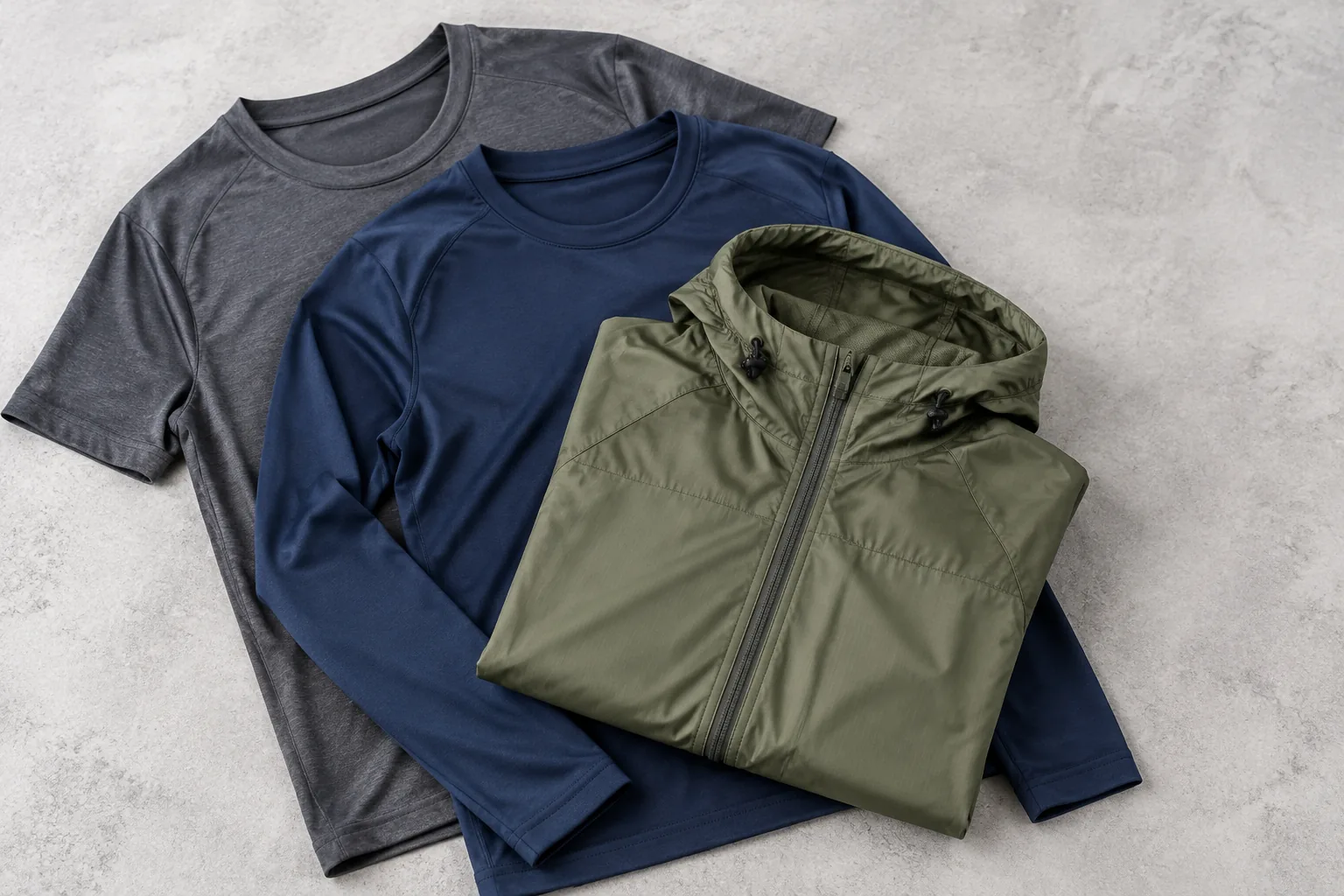
Cold Weather Race Season: Base, Mid and Shell for Late-Autumn Events
A race that starts at 8°C and finishes at 16°C is harder to dress for than one run in freezing conditions. The start line rewards insulation and the last five kilometres punish it, and most runners solve the problem by wearing too much and carrying the excess in their hands for an hour.
Getting cold weather running apparel right is a layering problem, not a warmth problem. Three layers with clearly separated jobs cover almost every late-autumn event, and knowing which layer to remove — and when — matters more than the fabric you choose for any single one.
Why late-autumn races are harder than deep winter
In January the answer is stable: it is cold at the start, cold in the middle, and cold at the finish. In November the temperature can move ten degrees during the race, and the sun angle changes what the wind feels like on an exposed section.
Deep winter also means you have already adapted. Late autumn catches runners in the transition, still dressing for the sessions they did three weeks ago. The result is a start line full of jackets that get tied around waists by kilometre six.
The three-layer model, and what each layer is for
Each layer answers a different question. Base manages moisture against the skin. Mid holds warmth that you can shed. Shell blocks wind and light rain while letting vapour out. When a garment tries to do two jobs, it usually does both badly.
| Layer | Job | Typical specification | Remove when |
|---|---|---|---|
| Base | Move sweat off the skin | 150 GSM knit, close fit, flat seams | Almost never mid-race |
| Mid | Hold warmth, shed easily | 180 GSM long sleeve or light grid fleece | Around 10–15 minutes in, once warm |
| Shell | Block wind and light rain | Lightweight woven, packable, vented back | On exposed sections, or not at all |
The table is a starting point, not a rule. The useful discipline is to decide before the race which layer comes off first, and to make sure that layer can be removed without stopping.
The base layer: what 150 GSM actually does
A 150 GSM knit is the workhorse weight for running tops. It is light enough that it does not feel like insulation, dense enough that it does not go transparent when wet, and it dries fast enough that a mid-race shower does not end the day.
Heavier base layers feel reassuring in the car park and become a liability on the course. If you are choosing between 150 and 180 GSM for a base, take the lighter one and put the difference into the mid layer, where you can take it off. Our fabric weight guide explains how the numbers translate into hand-feel and drying time.
Two construction details matter more than the weight. Flat seams or bonded seams under a pack strap, and a hem that stays down when you are moving. A base layer that rides up is a base layer that chafes.
The mid layer: when a second top is enough
For most club runners in November, a long-sleeve 180 GSM top over a base is sufficient down to around 5°C in still air. Below that, or in wind, the shell does more work than a heavier mid would.
The mid layer should be loose enough to come off over a wet base and light enough to tie around the waist without swinging. A custom long-sleeve training shirt in the same club colour as the race top solves the visual problem at the same time as the thermal one.
The shell: what a packable jacket has to do
A shell is judged on three things: whether it blocks wind at the chest, whether it vents enough that you do not cook inside it, and whether it packs small enough to carry once you take it off.
Wind resistance without ventilation produces the classic mistake — a runner sweating heavily inside a jacket at 2°C and freezing the moment they stop. A back vent or a lighter panel across the upper back is worth more than a heavier face fabric. Our running jacket page covers the construction choices, including how the hood behaves at speed.
Hands, head and legs
Extremities are where the cold is felt first, and they are the cheapest thing to get right. Gloves and a headband are removable in a way that a jacket is not, which makes them the most flexible part of the kit.
Legs are more forgiving. Most runners are comfortable in shorts down to around 5°C once warm, and a compression tight below that. The mistake is wearing tights for the start line temperature rather than the racing temperature.
When the start is cold and the finish is warm
This is the case that breaks most plans, and it has three practical answers. Wear a disposable or cheap outer layer that you shed at the start and never carry. Wear a shell that packs into its own pocket. Or accept carrying the mid layer and choose one that compresses.
Whichever you pick, rehearse it once in training. A layer you have never removed at pace will cost you time on race day, usually at the worst moment.
A worked example: a 12°C race with wind
Take a half marathon that starts at 12°C, climbs to 16°C by the finish, with an exposed section at kilometre seven. The correct cold weather running apparel combination is a 150 GSM base, a light mid layer, and a packable shell that comes off after the exposed section and stays off.
Most runners will over-dress this race. They will wear the shell for the whole distance because taking it off costs thirty seconds and feels like a risk, and they will finish dehydrated and overheated rather than cold. The layering was never the problem — the decision to remove a layer was.
Change one variable and the answer changes. Drop the start to 4°C and the mid layer should be a genuine 180 GSM top rather than a light one, and the shell becomes non-negotiable for the first twenty minutes. Raise the start to 16°C and the shell is only worth carrying if rain is forecast. The structure holds; the weights move.
This is why a club ordering cold weather running apparel for a season should decide the weights against its own race calendar rather than against a generic winter recommendation. A club racing in the south of England in November and one racing in the Alps in March need different layer sets even though both are buying winter kit.
What this means for club kit orders
Clubs buying cold weather running apparel in bulk face a distribution problem rather than a fabric problem. Not every member needs a shell, and the members who do tend to be the ones racing, not the ones training.
The practical approach is to treat layers as separate order lines rather than a single kit. Base layers in every size, mid layers in the middle of the range, shells in fewer sizes because they are worn over other garments. That keeps the total order sensible while covering the people who actually race in November. The same logic applies to accessories, where gloves and headbands are cheap to add and easy to size.
Frequently asked questions
Is a base layer necessary if I wear a jacket?
Yes, for anything longer than about thirty minutes. A shell does not move moisture, so without a base the sweat sits against the skin and you get cold as soon as the effort drops.
Cotton is fine for a short run in the cold, isn’t it?
It is fine until you sweat. Cotton holds water against the skin and loses insulation when wet, which is exactly the wrong behaviour for a cold-weather layer.
How do I size a shell worn over two layers?
Size it over the thickest combination you will actually wear, not over a t-shirt. If you are between sizes, take the larger one and use the hem adjustment rather than sizing down.
Do bonded seams matter on a winter top?
They matter most where something rubs — under a pack strap, at the shoulder, at the neckline. Bonding removes the stitch ridge that chafes once the fabric is wet.
Can a club order mixed layers in one batch?
Yes. Layers are separate styles, and a batch can contain several, with the minimum applying across the order rather than per style. Ordering from one piece upward is what makes a small winter order practical.
Build the winter layer set once
If your club races through November and December, decide the three layers now and order them as one specification you can repeat next season. Send us your race calendar and the temperature range you actually experience, and we will recommend the weights that fit. Start with the weight guide, look at the jacket and tight options, or request a quote for a mixed layer set.