
No products in the cart.

Custom Pickleball Club Apparel: Fit, Fabric and Print for Fast-Growing Leagues
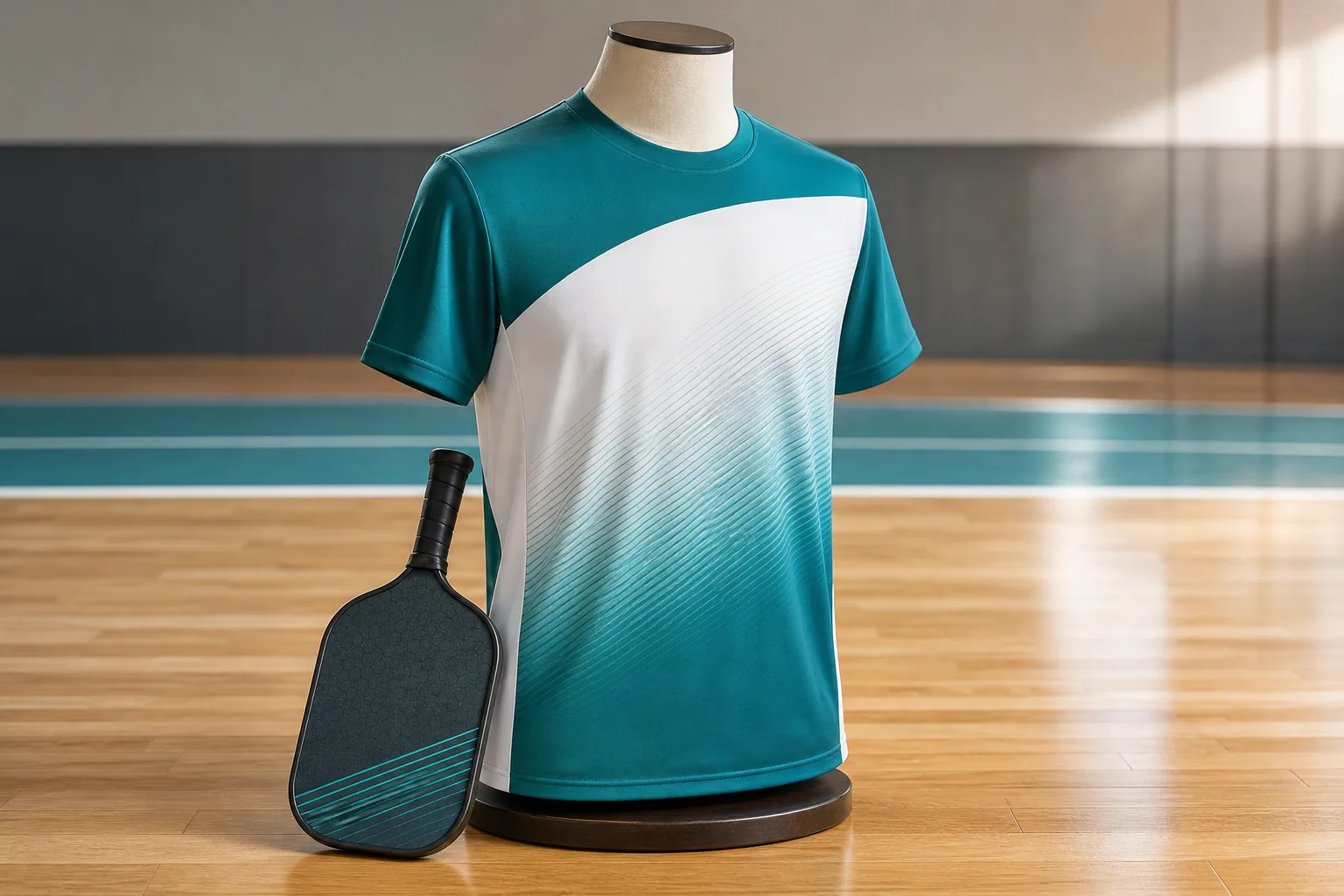
Pickleball grew faster than the apparel around it, and most clubs discover the gap between a printed shirt and real custom pickleball apparel somewhere in their second season. Most clubs started with whatever members already owned, then moved to a printed t-shirt when they wanted to look like a team, and only noticed the problem when players began complaining that the shirt rode up on the serve and that the print cracked after a season of indoor play.
That progression is normal, and it explains why commissioning custom pickleball apparel is not simply tennis kit with a different logo. The sport has its own movement pattern, its own mix of ages on a roster, and its own event culture — and each of those pushes the specification in a different direction.
Why pickleball kit is not tennis kit
Tennis is built around lateral recovery and a long swing. Pickleball is played in a smaller area, at the kitchen line, with far more forward-and-back movement and a great deal of low reaching. Players spend more time in a semi-crouch and much more time rotating from the waist than the sport’s visual similarity to tennis suggests.
Practically, that means the shirt hem gets pulled up repeatedly, the shorts get more stress at the crotch and inner thigh, and the shoulder seam sees more forward reach than overhead. A cut designed for a tennis serve does not address any of that.
The movement pattern and what it means for the cut
Three changes solve most of the comfort complaints we see in club orders. A longer shirt body, so the hem stays put when reaching forward. A gusseted or higher-stretch short, so the crouch position does not pull. And a raglan or offset shoulder seam, so the seam is not sitting directly under a bag strap between games.
None of these is exotic. They are standard pattern options, but they have to be asked for. A generic team shirt pattern will not include them by default, and that is why so many first pickleball orders end up as garments people wear to the event but not to play in. It is also the reason a club that has already bought printed shirts once often gets the second order right: the complaints have finally been specific enough to specify against.
If you are ordering custom pickleball apparel for the first time, it is worth collecting those complaints before the brief is written rather than after the sample arrives.
Matching the garment to the movement
It helps to work backwards from what the player actually does rather than from what the shirt should look like. Four demands account for nearly every complaint in a club order, and each maps to a specific construction answer.
| What the player does | What it stresses | Construction answer |
|---|---|---|
| Reaches forward at the kitchen line | Shirt hem and lower back | Longer body, curved hem, side vents |
| Holds a semi-crouch for long rallies | Crotch and inner thigh | Gusseted short, higher stretch content |
| Rotates from the waist | Side seam and lower back panel | Raglan or offset shoulder seam |
| Plays two or three hours per session | Moisture build-up inside a warm hall | Lighter knit, vented back panel |
Each of these is a small change to a standard pattern, and together they are the difference between a shirt that only looks like kit and one that players choose to wear. When a club asks us for custom pickleball apparel, this table is usually the first thing we walk through, because the answers are cheap at design stage and impossible to fix afterwards.
It is also worth saying what does not matter much. Sleeve shape is largely a preference. Collar or no collar is a preference. The hem length, the gusset and the shoulder seam are not preferences — they are the parts that determine whether the garment survives a season of play.
Fabric choice: 150 GSM or 180 GSM
Pickleball is usually played indoors, often in a hall with poor air movement, and often by players who are on court for two or three hours across a session. That combination favours the lighter end of the knit range.
A 150 GSM knit dries faster and feels cooler in a warm hall. A 180 GSM knit feels more substantial and holds print detail slightly better, which some clubs prefer for photographs and sponsor visibility. If the club plays both indoors and outdoors through the year, 150 GSM is the safer single choice, with the heavier weight reserved for outer layers. Our fabric weight guide explains what the difference feels like after ten washes.
Print: why sublimation suits club colours
Most pickleball club kit is designed with colour blocks, gradients, or a sponsor panel — the kind of artwork that is awkward to screen print economically at club quantities.
Sublimation handles that well. The colour is bonded into polyester fibre rather than sitting on top of it, so a full-colour design does not add cost per colour, and the print does not crack because there is nothing on the surface to crack. The constraint is the substrate: sublimation needs polyester, and it reads differently on light and dark grounds.
Where a club needs a crest on a cotton-blend shirt, or a small number on the back, a transfer or embroidery is the better route for that single placement. The comparison of methods, including cost behaviour at club quantities, is in our printing and decoration reference.
Sizing across a mixed-age roster
This is the defining operational problem in pickleball. A single club can run from teenagers to players in their seventies, and the size distribution looks nothing like a running club’s.
Two things help. First, order by measured size rather than by stated size — a simple chest and length measurement sheet circulated to members removes most of the guesswork. Second, expect the extremes to be wider than a standard grade covers, and ask for the pattern to be adjusted rather than telling the largest and smallest players to compromise.
A mixed-size run inside one batch is normal, and the minimum applies across the batch. That is what makes a thirty-person club with eight sizes workable — see MOQ and tier pricing for how quantities interact.
Tournaments, sponsors and numbering
Club kit usually has to do two jobs: represent the club at weekly play, and carry sponsor marks at events. Those pull in opposite directions, because a sponsor panel is only worth selling if it is legible.
Decide the sponsor zone before the design is finalised, and keep it clear of the areas that crease or stretch most — the side seam under the arm and the lower back on a crouching player. A name and number on the back should be sized for reading at ten metres, not for looking neat on a flat lay.
A sample order that answers the questions
Before committing a club to a full run, order one sample in the largest and one in the smallest size, made to the actual specification. Wear them for two sessions. The things that will go wrong — hem lift, shoulder seam position, print placement on a moving body — show up within an hour of real play and are invisible on a hanger.
Sampling typically takes five to seven days, and the approval step is where the pattern notes get locked in for the bulk order. Our sampling and approval guide covers what to check when the sample arrives.
Frequently asked questions
Can we order pickleball kit from one piece upward?
Yes. Orders start from one piece, which makes it practical for a club to test a design with a few players before committing to a full run.
Is sublimation suitable for indoor courts?
Yes, and it is the usual choice for full-colour club designs. The print is inside the fibre, so it does not crack with repeated washing, which matters for kit worn several times a week.
What fabric weight do most clubs choose?
150 GSM is the most common for indoor play in a warm hall. Clubs that play outdoors through summer often choose the same weight and add a heavier warm-up layer rather than changing the playing shirt. When we quote custom pickleball apparel for a club that plays both, the weight stays at 150 GSM and the second layer is quoted as a separate style.
Can we put sponsor logos on the shirt?
Yes. Sponsor zones are defined at design stage so they stay legible on a moving player, and they can be combined with club colour blocking in a single sublimated print.
How do we handle players who join mid-season?
Keep the pattern and the print file on record. A late joiner then becomes a small reorder in the same specification rather than a mismatch on the court.
Start with two samples, not thirty shirts
Pickleball clubs usually get the fabric right on the first attempt and the pattern wrong. Testing the extremes in a sample run is the cheapest way to find that out. Send us your roster’s size range and your sponsor requirements, and we will propose a specification for the hall you actually play in. Browse custom sports shirts and running shorts for the base styles, or request a quote with your club details.