No products in the cart.

Inside a 3000 m2 Sportswear Factory: The Eight Stations Your Order Passes Through
Most buyers see a finished garment and a delivery date, with a black box in between. That black box is where delays, colour problems and sizing disputes actually originate — which is why understanding the sportswear factory production process is one of the most useful things a buyer can do before placing a first order.
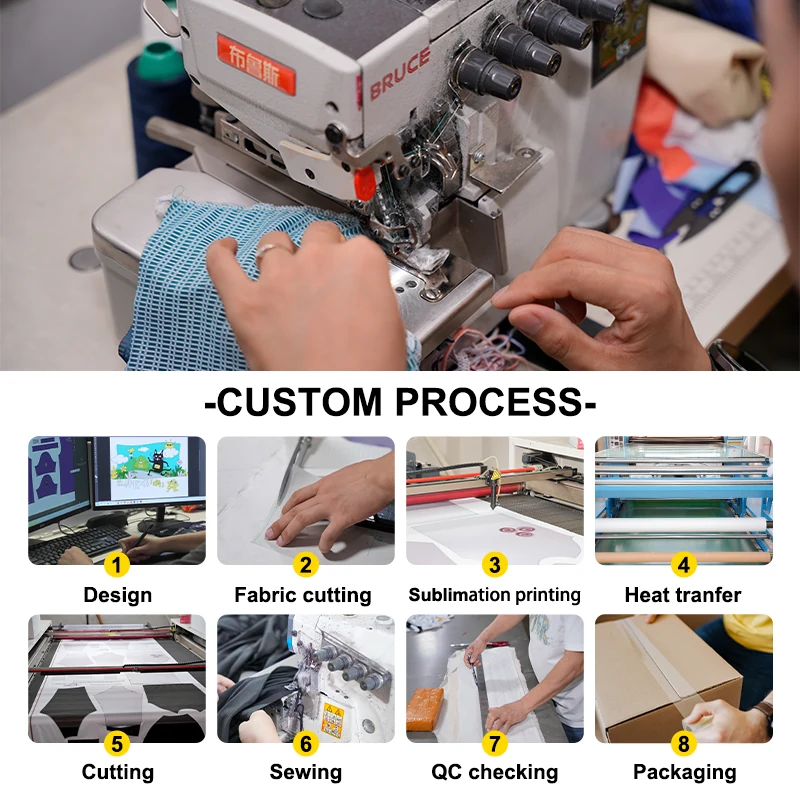
Our facility covers 3000+ m² and runs with 100+ workers. An order passes through eight stations on its way from artwork to a sealed carton. This article walks through all eight, explains what happens at each one, and — more usefully — tells you what you should be approving at each stage so that nothing arrives as a surprise.
Overview: the eight stations
| # | Station | What happens | What you should approve |
|---|---|---|---|
| 1 | Design | Tech pack converted into pattern, artwork separated by colour and size | Tech pack accuracy, placement and size grading |
| 2 | Fabric cutting | Fabric inspected, relaxed and cut into panels | Fabric quality and weight against the spec |
| 3 | Sublimation printing | Artwork printed to transfer paper, then bonded into polyester panels | Colour against the approved lab dip |
| 4 | Heat transfer | Names, numbers, sponsor marks and small logos applied | Position, size and reading distance |
| 5 | Cutting and trimming | Printed panels trimmed to final size, matched into sets | Panel matching, especially on all-over prints |
| 6 | Sewing | Panels joined; collars, cuffs, waistbands and trims attached | Seam type and stitch density |
| 7 | QC checking | Measurement, visual inspection, seam and print check | Inspection standard and acceptable defect level |
| 8 | Packaging | Folding, size labelling, polybagging, carton packing | Labelling format and carton marks |
Station 1 — Design
A tech pack is translated into a pattern and a set of artwork files separated by colour and by size. This is where most quality is decided: a placement that is wrong here will be wrong on every garment, no matter how good the sewing is.
What we ask buyers to check at this stage: that the tech pack states placement relative to a measurable point (collar seam, side seam, hem) rather than “centred”; that logos are supplied as vector files; and that sizing is graded across the full range rather than extrapolated from one size. If you are unsure what belongs in the pack, our guide to custom sports t-shirts covers the artwork side in more detail.
Station 2 — Fabric cutting
Fabric is inspected for faults, allowed to relax, then cut into panels. The relaxation step matters more than it sounds: polyester-elastane that is cut immediately after unrolling will shrink back after sewing and pull the measurements out of tolerance.
This is the last cheap moment to catch a fabric problem. Once panels are cut, a wrong weight or a shade difference becomes expensive.
Station 3 — Sublimation printing
Artwork is printed onto transfer paper, then bonded into polyester panels under heat and pressure. Sublimation is what makes all-over designs, gradients and photographic prints possible on sportswear — and it is also the station where colour drift usually begins.
Two variables control the result: the ink batch and the press settings. Both are recorded against your order so that a reorder can repeat them. If you order running singlets with an all-over print, approve a printed panel rather than a paper proof — paper and fabric do not read the same.
Station 4 — Heat transfer
Names, numbers, sponsor marks and small logos are applied here. Position is the recurring problem: a number that sits two centimetres low reads as a manufacturing error to the player wearing it, even though it is inside most published tolerances.
For club and event orders we recommend approving one complete decorated garment — front, back and sleeve — rather than separate position drawings. It is faster to see a mistake than to read for one.
Station 5 — Cutting and trimming
Printed panels are trimmed to final size and matched into sets. On all-over prints this is where panel matching happens: a chevron that does not meet at the side seam is a common complaint on inexpensive custom kit, and it is fixed here rather than at sewing.
If your design has a continuous graphic across seams, agree the tolerance in writing before production. Perfect matching on every piece is possible but costs cutting time; a small tolerance is usually the better commercial trade.
Station 6 — Sewing
Panels are joined and the garment is built: collars, cuffs, waistbands, hems and trims. Our custom polo shirts use a different collar construction to our running shorts, and both are specified at this station rather than at design.
Seam type is the decision that most affects durability. Flatlock lies flat and stretches with the fabric, which is why it is used on stretch sportswear; overlock is faster and stronger in a straight line but creates a ridge. If you want the comparison in detail, our seam guide covers lockstitch, overlock and flatlock side by side.
Station 7 — QC checking
In our experience buyers judge the sportswear factory production process almost entirely on this station, because it is where problems become visible — but the cause of those problems almost always sits earlier, at design or at printing.
Every garment is measured against the size chart, inspected visually, and checked for seam and print faults. Most factories inspect to an acceptable quality level rather than to zero defects — the level agreed here determines how many garments are pulled.
What buyers should do: state the inspection standard in the purchase order, and ask for the inspection record with the shipment. A factory that cannot produce that record on request is not inspecting to a standard.
Station 8 — Packaging
Garments are folded, labelled, polybagged and packed into cartons with the correct carton marks. This station is unglamorous and disproportionately important for e-commerce sellers, where a mislabelled size becomes a return rather than a delivery.
Specify the labelling format early: individual polybag with size sticker, or bulk-packed by size. If you sell direct to consumer, individual bagging with a barcode is usually the right choice and is far cheaper to plan than to retrofit.
Where orders actually slip
Across thousands of orders, delays rarely come from sewing capacity. They come from three places:
- Artwork arriving late or incomplete — vector files, placement measurements and size grading are the usual gaps.
- Approval rounds — each unapproved sample adds a full sampling cycle. Our sampling runs 5–7 days; three rounds is three weeks.
- Fabric substitution — a discontinued quality discovered at station 2 stops the order after the pattern is already made.
Production itself ships in 15 days once a sample is approved. The variable is almost always the front end, not the floor.
It also helps to know which stations you can actually influence. Buyers control stations 1, 4 and 8 almost entirely — the tech pack, the decoration approval and the packing instruction. Those three decisions are cheap to change before production and expensive to change afterwards. The middle four stations are ours to run, which is exactly why the sportswear factory production process is worth walking through once with a new supplier: it moves the conversation from “when will it ship” to “what do you need from me”.
Frequently asked questions
How long does the whole process take?
Sampling takes 5–7 days. Once the sample is approved, production ships in 15 days. Artwork preparation and approval rounds sit outside both figures and are the usual cause of a longer total.
Can I visit the factory or see the stations?
Yes. Buyers are welcome to review the floor and the inspection station in person, and we can also send photographs of your order at each stage if you are ordering remotely. Our gallery shows finished production for reference.
What is the minimum order quantity?
One piece. We are set up for sampling and small first orders, which is why our custom sports jackets and compression tights pages both start from single units.
Do you inspect every garment or sample a percentage?
We inspect to an agreed acceptable quality level, which is industry standard and is stated in the purchase order. Full inspection is possible but changes both cost and lead time, so it should be agreed at the start rather than assumed.
Where do most first orders go wrong?
Artwork. Incomplete vector files and unmeasured logo placement cause more delay than any production issue. Sending a complete tech pack is the single highest-leverage thing a new buyer can do.
Send us a tech pack and we will map your order
If you want to know exactly which stations your order will pass through and what needs approving at each one, send the tech pack and we will return a station-by-station plan with a timeline. Start with the contact form — we reply with a sampling date and a production window.