
No products in the cart.

The Eight Print Methods for Custom Sportswear, and When to Use Each
A design brief says “full colour, front and back, plus a number”. The supplier comes back with three possible methods and a price difference. Nobody in the room knows which one produces the garment the club actually wants, so the cheapest option wins — and six washes later the number is cracking.
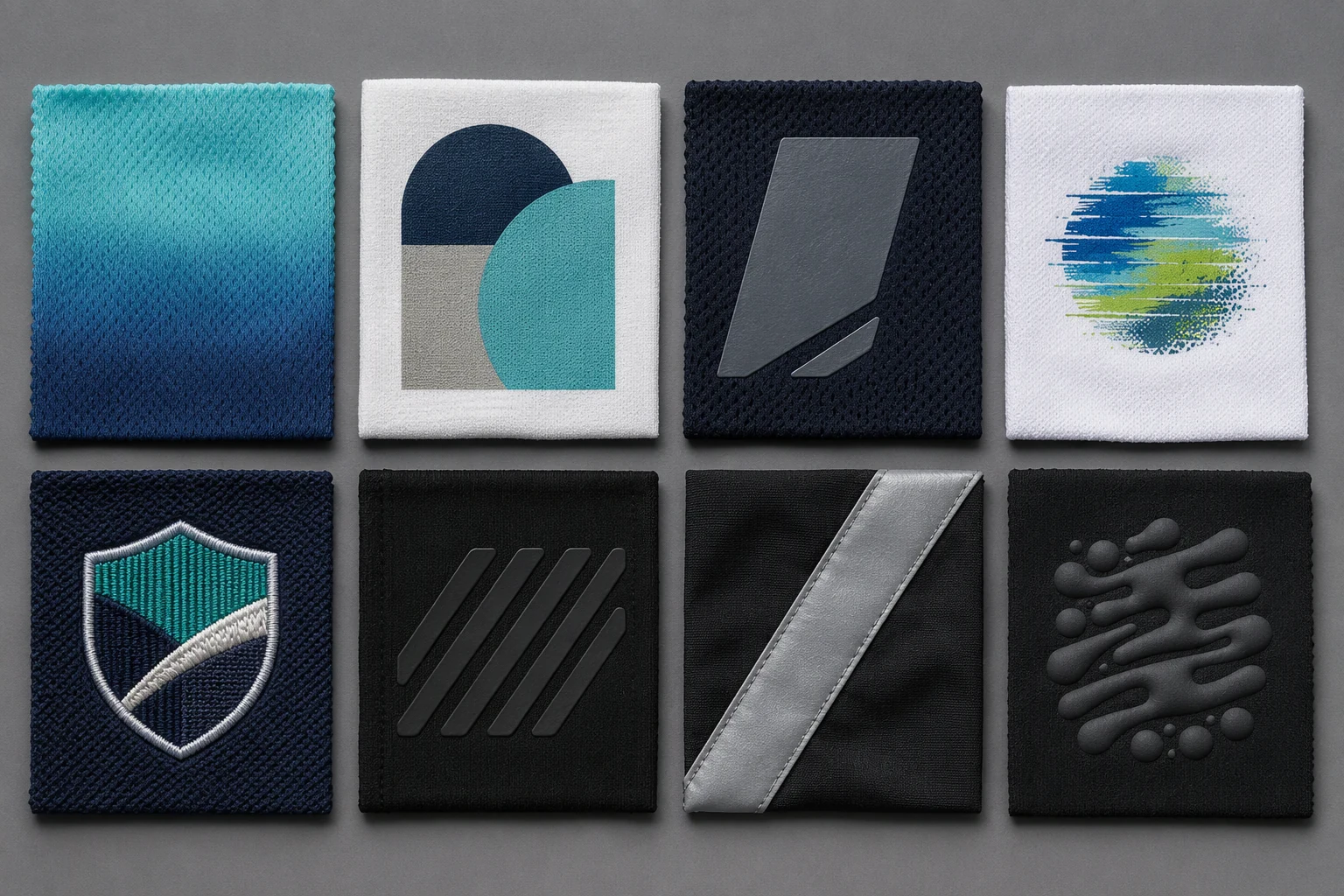
Decoration is where most of the visual and durability differences in custom sportswear are decided. We work with eight custom sportswear printing methods, and choosing between them is mostly a matter of matching the method to the substrate and to the design, not of picking a favourite.
The eight methods at a glance
| Method | How the colour sits | Best suited to | Watch out for |
|---|---|---|---|
| Sublimation | Bonded into polyester fibre | All-over designs, gradients, photographic prints | Polyester only; colour reads differently on light fabrics |
| Screen printing | Ink layered on the surface | Bold spot colours on solid grounds | One screen per colour; expensive on small runs |
| Heat transfer | Printed film pressed on | Names, numbers, small logos | Under-curing fails quietly |
| Digital direct | Ink printed straight to garment | Short runs with many colours | Hand-feel on dark fabrics |
| Embroidery | Stitched thread | Crests, small marks, polos | Dense artwork distorts; stitch count drives cost |
| Silicone print | Raised elastomer layer | Premium marks, grips, elastic trims | Heavier hand-feel; cure quality matters |
| Reflective transfer | Retro-reflective film | Evening running, safety detail | Reflectivity drops if washed hot |
| Puff print | Expanding ink layer | Retro styling, bold graphics | Thicker feel; not suitable on high-stretch panels |
Why the substrate decides before the design does
Sublimation needs polyester. Put it on cotton and the dye has nothing to bond to. That single constraint rules out sublimation for a cotton-rich polo, which is why classic club polos usually carry an embroidered crest instead.
Conversely, screen printing on a lightweight stretch jersey can crack at the panel seam because the ink layer does not stretch with the fabric. The design looked fine flat; it failed at the first sprint.
The practical rule: choose the fabric first, then the method that the fabric accepts, then adjust the artwork to suit the method.
Matching method to garment
Running singlets and lightweight tops
Almost always sublimation, because the garments are polyester and the designs are graphic. A custom running singlet with an all-over club pattern is sublimation by definition. Names and numbers may still be applied as transfers if they are added after printing.
Sports t-shirts
The most mixed category. A polyester training tee takes sublimation; a cotton-blend tee takes screen printing, digital direct or transfer. Our guide on custom sports t-shirts breaks down which blank suits which method.
Polos
Crests. Embroidery is the default for a reason: it survives laundering, looks deliberate and does not crack. A large graphic on a polo is usually a mistake for the same reason a small embroidered crest is not.
Jackets and outerwear
A mix. Body panels may be sublimated or plain, while reflective detail and sponsor marks go on as transfers. See custom sports jackets for the constructions we build most often.
The economics nobody explains up front
| Method | Behaviour at small quantities | Behaviour at scale |
|---|---|---|
| Sublimation | Efficient — no per-colour setup | Efficient; cost is mostly fabric and time |
| Screen printing | Expensive — every colour needs a screen | Cheapest per unit for spot colour |
| Heat transfer | Cheap and flexible | Labour-heavy on high volumes |
| Embroidery | Cost driven by stitch count | Economies come from reducing colours and density |
This is why the same artwork can be quoted very differently by two suppliers: they are not necessarily pricing the same method. Always ask which method the quote assumes.
Five questions that prevent most decoration problems
- Which method is this quote based on, and what substrate does it assume?
- Is the artwork supplied as vector, and is each colour separated?
- Will the method stretch with the panel it sits on?
- What curing temperature and time will be used, and is it recorded?
- Has a wash test been run on a decorated sample, not a plain one?
Question four is the one buyers rarely ask and the one that causes the most quiet failures. Under-cured transfer looks perfect on day one.
Mixing methods on one garment
Most of the kits we build use at least two methods. An all-over sublimated singlet with a heat-transferred number and a silicone hem detail is a normal specification, not a complicated one. The methods are chosen per element, which means the brief has to describe each element separately.
Where mixing goes wrong is at the boundary. A silicone print applied over a sublimated panel behaves differently from silicone on a plain panel, because the ink layer underneath changes how the elastomer bonds. A reflective transfer and a screen print on the same chest panel can interfere with each other if the order of application is not planned.
The practical instruction is to describe the garment by zones — front body, back body, sleeve, hem, trim — and state the method for each zone. That single change in how a brief is written removes most of the ambiguity that leads to a supplier choosing the cheapest interpretation of “print the crest”.
Where decoration goes wrong most often
Three patterns repeat across orders:
- Method chosen for price, not substrate. A cheap transfer on a stretch panel will crack at the seam.
- Artwork not separated by colour. Screen printing cannot proceed from a flattened image, and the delay lands on the club.
- Placement described, not measured. “Centred” is not a specification; a distance from a seam is.
All three are decided before production starts, which is the cheapest possible moment to fix them.
Sampling a decoration before committing
Decoration is the part of a garment that cannot be judged from a photograph. Two custom sportswear printing methods applied to the same artwork produce results that look similar on screen and completely different in hand. That is why a decoration sample is not optional on a first order.
What to look for on the sample, in order:
- Hand-feel. Run a thumb across the print. A thick, rubbery edge on a lightweight singlet will be uncomfortable at the armhole.
- Edge definition. Fine type and thin lines are where cheap methods fail first. If small text fills in, the method or the artwork is wrong.
- Stretch behaviour. Stretch the printed panel across the grain. Cracking at this stage will become cracking in the wash.
- Coverage on dark grounds. A white design on a black garment is the hardest test for any method. Approve it on the actual colour.
The practical advantage of comparing custom sportswear printing methods side by side on the same fabric is that the trade-off becomes obvious rather than theoretical. A club that sees a sublimated panel beside a transferred one stops arguing about price and starts choosing.
One caution: a decoration sample is a sample of a process, not a guarantee of a production run. Ask what changes between sample and production — different press, different operator, different batch — and get the answer in writing. Most decoration failures we see are not method failures; they are process drift between the sample room and the floor.
Frequently asked questions
Can one garment use more than one method?
Yes, and most good kits do. An all-over sublimated singlet with a heat-transferred number and a silicone hem detail is normal. The methods are chosen per element, not per garment.
Why is screen printing more expensive on a small club order?
Each colour requires its own screen, and the setup is charged once regardless of quantity. At 30 pieces the setup dominates; at 3,000 it disappears into the unit cost.
Can you print a photograph on a singlet?
Yes, through sublimation. Photographic artwork needs a high-resolution file and works best on lighter grounds, because the print sits inside the fibre and follows the base colour.
Will reflective print still reflect after washing?
It should, if cured and washed correctly. Hot washes and tumble drying degrade retro-reflective film faster than normal wear does, so specify the care instruction alongside the decoration.
Do you charge for artwork preparation?
Artwork requirements and any preparation charges are confirmed at quotation. Sending vector files with colour separation already done removes most of that cost.
Send the artwork, get a method recommendation
If you are unsure which method suits your design, send the artwork with the intended fabric and quantity, and we will recommend the method we would use and explain the trade-off. Browse finished decoration in the gallery, or request a quote with the files attached.