

No products in the cart.

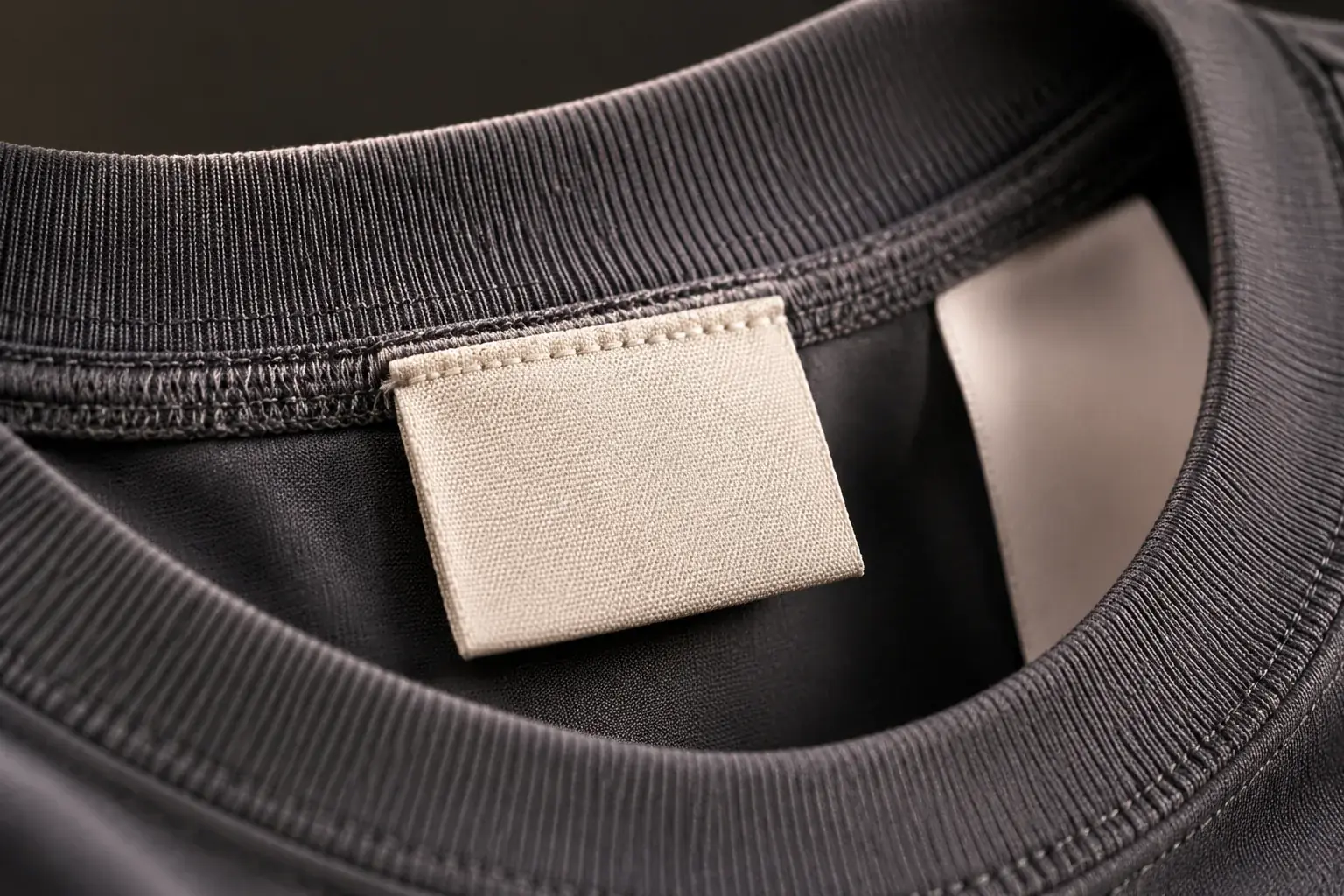
Neck Labels, Care Labels and Hang Tags: Specifying Branding That Survives the Wash
A neck label costs a few cents and decides whether a garment reads as a brand or as a blank. A care label costs less and decides whether the customer washes it correctly — or returns it after one cycle. Hang tags cost almost nothing and are the first thing the buyer touches in a shop.
Together they are the cheapest branding decision in a custom sportswear order and the one most often left to the last week. This guide covers the three label types, where each belongs, and how to approve a proof so that what arrives matches what you approved.
Three labels, three different jobs
A neck label identifies. A care label instructs. A hang tag sells. They are printed on different materials, attached in different places, and evaluated against different standards — which is why bundling them into one “labelling” line in a tech pack usually ends in a mismatch.
| Label | Position | Typical material | Most common failure |
|---|---|---|---|
| Neck label | Inside back neck, or printed directly | Woven polyester, or heat transfer | Scratchy edge; print washing out |
| Care label | Inside left side seam, 10–15 cm from hem | Woven polyester or coated nylon | Illegible after repeated washing |
| Hang tag | Attached to neck or armhole | Coated card, 300–400 gsm | Too heavy for fine knits; tears the garment |
Woven versus printed neck labels
A woven label is a separate piece of fabric, folded and stitched into the neck seam. It carries fine detail well, survives washing, and feels like a garment label. It also adds a seam and a folded edge against the skin, which is the source of most “scratchy neck” complaints.
A printed or heat-transfer neck label is applied directly to the fabric, and it is the default in most custom sportswear production for exactly that reason. There is no seam and nothing to rub, which is why it dominates performance apparel. The trade-off is durability: the print sits on the fibre, so it can fade or flake with heat and repeated washing, and it must be cured correctly.
For running and training kit, printed neck labels are usually the better default. For polos and heavier cotton blends, a woven label reads as more premium and the collar hides the seam. Our custom polo page shows both approaches in finished garments.
What has to appear on a care label
In most markets, fibre content and country of origin are regulated, and care instructions must be accurate enough that following them does not damage the garment. The exact wording and symbol requirements differ by country, so the wording should be confirmed with your compliance contact rather than copied from another product.
What a factory can do is make sure the label is legible and the instruction is right for the actual construction. That means the label must reflect how the garment was made, not how the style was originally designed. If the decoration changed from screen print to heat transfer, the wash instruction may need to change with it — and the label has to follow.
Symbols matter as much as words. A tumble-dry symbol on a garment with heat-transfer decoration is an instruction to destroy it, and a customer who follows the label cannot be blamed for the result.
Hang tags: what buyers actually keep
In custom sportswear the hang tag is often the only piece of printed paper in the order, so it carries more brand weight than its cost suggests. Most hang tags are thrown away within a minute of purchase, and that is fine — their job is done in that minute. What matters is weight, finish, and how they are attached.
A 300–400 gsm coated card reads as substantial without being stiff. Anything heavier starts to mark a fine knit where it hangs. Attachment matters more than most buyers expect: a plastic barb through a fine mesh leaves a hole that does not close, so a loop of string or a safety pin through a seam allowance is safer on lightweight fabrics.
For ecommerce sellers, the tag also has a second life in photography. A tag visible in a flat lay or a product shot signals that the garment is finished rather than a sample — see the private label and ecommerce guide for how that fits into a listing.
Attachment methods and comfort
There are four common ways to attach a neck label, and each has a comfort consequence. A folded woven label stitched into the neck seam is durable and can rub. A flatlock-attached label on a performance top is smoother but relies on the seam quality. A printed label has no attachment at all. A tag-less transfer sits on the inside back neck and must be positioned below the collar line so it does not catch.
Whichever you choose, specify the position in centimetres from the neck seam. “Inside back neck” is not a specification, and a label placed 2 cm too high will be felt on every run.
Approving a label proof
The proof is where most labelling problems are created, because a screen proof is not a print proof. Check four things: the actual size in millimetres, the thread or ink colour against a physical reference, the text at final size rather than zoomed in, and the fold position on a woven label.
Text that is legible at 400% on a monitor is often illegible at 20 mm wide on a garment. Print the proof at actual size and read it at arm’s length. That single test catches most label rejections before production.
The same applies to the care label: if the fibre content or the wash symbol cannot be read at actual size, the label is not doing its job regardless of how it looks on screen.
What buyers notice without knowing they noticed
Nobody has ever returned a garment because a neck label was well positioned. But the reverse happens constantly, and it is worth being explicit about the signals.
A care label that is stiff and sits near the side seam edge will scratch on a long run. A hang tag looped through the neck rib rather than the seam allowance will leave a permanent stretch mark before the garment is even sold. A printed neck label placed too high catches on the collar and lifts at the corner after ten washes.
In custom sportswear these are not cosmetic issues. They are the small frictions that determine whether a garment feels considered. A club ordering thirty shirts will not inspect the labels, but every player will feel them, and the feedback will surface as a general sense that the kit is not quite right.
The reverse is also true, and it is a cheap win. A tag that matches the garment colour, a care label that is soft against the skin, and a hang tag heavy enough to feel intentional — together they cost very little in a custom sportswear order and they are the first physical evidence that someone thought about the product. For brands selling online, where the buyer cannot touch the garment before purchase, that evidence carries more weight than it does in a shop.
Sequencing labels into the order
Labels are usually the last item specified and the first to delay a shipment, because they sit outside the garment production schedule. The practical fix is to approve label artwork at the same time as the garment sample, not after it.
That keeps the label inside the same production window. Our sampling and approval guide sets out the approval sequence, and the inspection reference covers what is checked on the finished garment — including label position and legibility.
Frequently asked questions
Can we use our own label supplier?
Usually yes, if the labels arrive before production starts and match the specified size and attachment method. Supply them early — late labels are the most common reason a finished order waits.
Printed or woven neck label for running kit?
Printed, for comfort. There is no seam against the neck, which matters on a garment worn repeatedly and washed often, and it is the default we recommend for running kit in custom sportswear. Woven suits polos and heavier knits where the collar covers the seam.
Do hang tags have to be attached by the factory?
No. Many brands attach them at their own warehouse, which lets one tag serve several styles and avoids damage in transit. If the factory attaches them, specify the method for the fabric weight.
What if our care instructions differ by market?
Use a multi-language care label or a market-specific one. Confirm the required content with your compliance contact first, then have the label produced to that wording rather than adapting it afterwards.
Can labels be added to a reorder?
Yes, if the artwork is on file. Keeping the approved label proof with the order record is what makes a reorder of ten pieces straightforward.
Specify labels with the sample, not after it
Send your label artwork, care wording and hang tag design together with the garment brief, and treat them as part of the custom sportswear specification rather than as an afterthought, and we will confirm sizes, materials and attachment in the same approval round. Start with the private label guide, look at finished labelling in the gallery, or request a quote with your artwork attached.