
No products in the cart.

Marathon Season Kit Checklist for Clubs
Every autumn the same message lands in a club secretary’s inbox: the race calendar is out, and the kit needs to be sorted. Then nothing happens for six weeks, and three weeks before the first race somebody asks whether it is too late. It usually is — not because factories are slow, but because nobody worked backwards from race day.
This is the checklist we would hand a club planning a custom marathon kit, in the order the decisions actually have to be made. It assumes nothing about the size of the club and everything about the calendar.
Start from the race date, not the order date
Two production numbers set the whole schedule: sampling takes 5–7 days, and production ships in 15 days after the sample is approved. Everything else — artwork, committee sign-off, size collection, numbering lists — happens in the gaps around those two numbers.
The trap is approval rounds. Each unapproved sample restarts the 5–7 day cycle. A club that needs three sample rounds has spent three weeks before production begins.
| Weeks before first race | What must be finished | Who owns it |
|---|---|---|
| 12 weeks | Kit decided: which items, racing or training, one kit or two | Committee |
| 10 weeks | Artwork approved: crest, colours, sponsor placement | Designer / committee |
| 9 weeks | Size set collected, including the extremes | Team managers |
| 8 weeks | Sample ordered; fabric and print method confirmed in writing | Supplier |
| 7 weeks | Sample approved on a fit model, not from a photograph | Committee |
| 6 weeks | Production released; numbering list locked | Supplier / club |
| 2 weeks | Delivery, count check, size swaps within the run | Club |
Twelve weeks is the comfortable number. Eight weeks is achievable if the artwork is already final and the first sample passes.
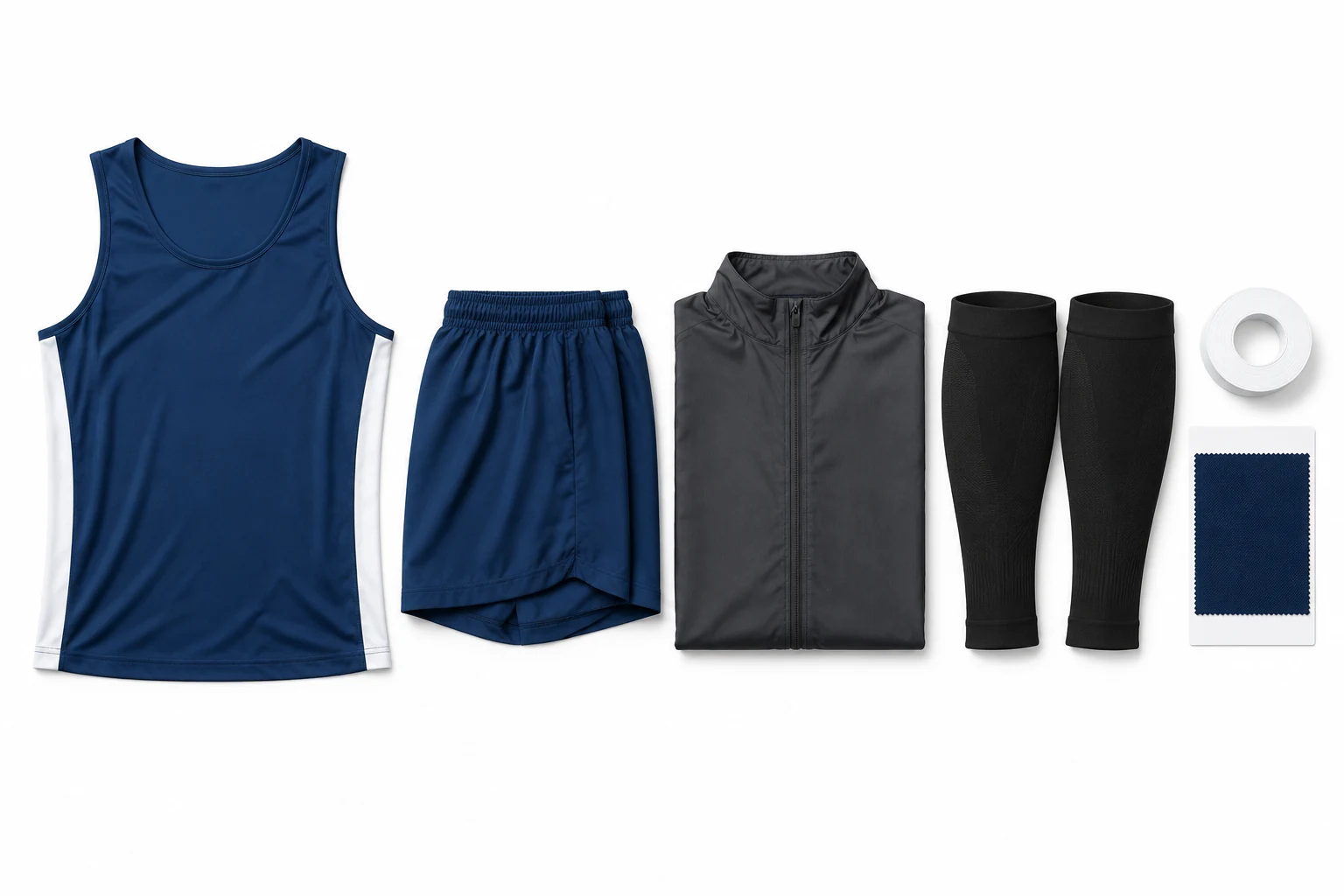
The five items that make up a working race kit
1. The racing top
Racing cut or relaxed cut is a club decision. What matters in production is the armhole depth and where the side seam sits — both are chafe points over 42 km. Approve on a fit model. Our custom running singlets page covers the two constructions we build most.
2. The racing short
Inseam length is the decision buyers underestimate. A 2-inch split short is faster and less forgiving; a 5-inch short suits more body types and more club members. Decide whether the club is dressing the front of the field or the whole membership.
3. The warm-up layer
Most clubs skip this and regret it: the hour before a race is cold, and a club without a warm-up layer photographs badly and looks disorganised on the start line. A light custom sports jacket with the crest solves it and is the item members actually wear afterwards.
4. Sleeves and small accessories
Compression leg sleeves have become a near-standard club item because they are cheap to add to an order and visible on course. They are also the easiest item to get wrong on sizing, so include them in the size set rather than ordering blind.
5. Numbering and names
Numbering is free design work and paid production work. Collect the list early, decide the font and the placement, and lock it before production release. Late numbering changes are the single most common cause of a shipment leaving incomplete.
Sizing: the step clubs get wrong
Collect sizes from the extremes, not the middle. Ask for the smallest and largest member in each squad, then fill in the middle. A size set built from averages produces a kit where two or three people cannot wear what they were sent.
- Collect chest (and waist for shorts) rather than “medium” or “large”.
- Include growth allowance for junior members.
- Expect 5–10% of the order to need swapping, and plan the buffer.
If the club is also ordering training kit, read our guide to custom sports t-shirts — the sizing logic is the same but the fit tolerance is more forgiving.
Artwork: what to settle before the supplier sees it
Three things stall artwork approval more than anything else:
- Vector files. A crest pulled from a website is a raster image and will not print cleanly at scale.
- Placement measured, not described. “Centred on the chest” is not a placement. “120 mm below the collar seam, centred” is.
- Sponsor hierarchy. Decide which marks are primary before the designer starts, or the committee will debate it for three meetings.
Sponsors add a second approval loop that clubs rarely budget for. A sponsor’s marketing contact usually has their own brand rules, their own preferred lock-up and their own timeline, and none of that moves at the speed of a club committee. Where a custom marathon kit is carrying third-party marks, get written sign-off on the mock-up before the sample is ordered, not after. It is the difference between one sample round and three.
Keep the approved artwork and its measurements in one place — a single PDF that states placement for every element. It becomes the reference document for reorders, and it is the only thing that survives a change of club secretary.
What the club should receive, and check on arrival
| Check on delivery | What to look for |
|---|---|
| Count by size | Matches the purchase order, not the total |
| Numbering | Every number present and in the agreed font |
| Colour against sample | Compare in daylight, not under indoor lighting |
| Print adhesion | Damp white cloth rub on a number and on the crest |
| Seams at armhole | Flat, no ridge, no loose thread |
Do this before the kit is distributed. Once members take garments home, every issue becomes a conversation rather than a correction.
The two decisions that decide whether the kit gets worn
After a few seasons, the pattern in what clubs regret is consistent. It is almost never the colour, and rarely the price. It is fit and it is fabric weight.
Fit. A custom marathon kit that is graded from a single sample will leave somebody uncomfortable. Race singlets sit close to the body, so a centimetre at the armhole is not a rounding error — it is a garment somebody will refuse to wear on race day. The fix is unglamorous: measure the extremes, build a size set, and approve on real people rather than on a hangar.
Weight. Clubs often ask for the lightest fabric available because light reads as fast. In practice the lightest option is also the least forgiving: it clings, it shows through on pale colours, and it photographs badly when wet. A slightly heavier weight nearly always produces a kit members are happier to be seen in, and the difference over 42 km is smaller than the difference in how it looks on the start line.
There is a third factor worth naming because it affects reorders: standardisation. A club that defines its custom marathon kit once — fabric, print, size set, numbering format — can reorder in future seasons without restarting the design process. That documentation is worth more than any single season’s price negotiation, because it is what makes the second order fast and the colour consistent.
If the club is ordering the full set, decide the racing kit first and let the training kit follow the same colour and print decisions. Two separate design processes produce two kits that do not look related, which defeats the purpose of a club identity.
Frequently asked questions
How late is too late to order race kit?
Under six weeks, a custom run becomes risky because a single failed sample consumes most of the remaining time. At that point, buying retail stock for the race and ordering custom kit for the following season is usually the better decision.
Should the club order racing kit and training kit together?
Yes where possible. One production window keeps colour consistent and usually reduces cost per unit, because setup is shared.
Can members order individually later?
Yes. Our minimum is one piece, so a member who joins mid-season can be supplied without reopening a bulk order — provided the original specification was documented.
What is the most common cause of a late kit?
Artwork. Incomplete vector files and unmeasured placement delay more orders than production capacity does.
Do you supply samples for committee approval?
Yes. Sampling runs 5–7 days, and we recommend approving on a fit model in the actual production colour rather than from a photograph.
Work backwards from your first race
Send us the race date, the items you need and the number of members, and we will return a schedule with the latest possible approval date for each decision. See finished club kits in the gallery, or request a quote to start the calendar.