
No products in the cart.

Lockstitch vs Flatlock vs Overlock Seams: Choosing the Right Stitch for Stretch Sportswear
Nearly every stitching decision in stretch sportswear returns to one comparison: flatlock vs overlock seams, and where a lockstitch still belongs. The choice changes how a garment moves, how the join feels against skin, and whether a seam survives a season of washing. Buyers who settle it early avoid the most expensive kind of rework — a sample that looks correct on a mannequin and performs badly on a runner.
This guide covers what each stitch does, where it fails, and how to write it into a tech pack so the factory quotes and builds exactly what you approved.
What Each Seam Actually Does
Three stitch types cover almost all stretch sportswear. They are not interchangeable, and no single one is correct across a whole garment.
Lockstitch
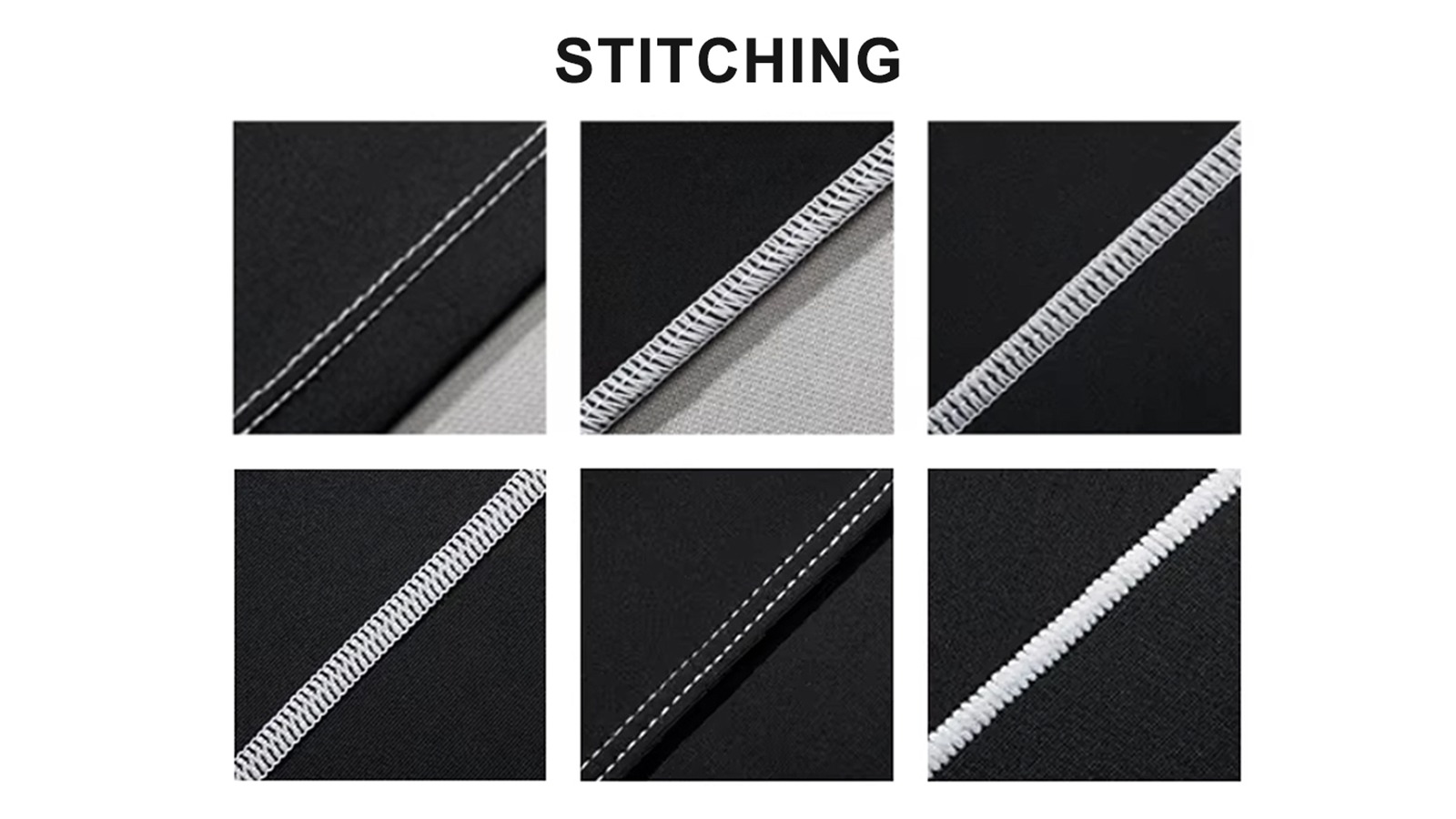
A lockstitch uses two threads — one above the fabric, one below — that interlock in the middle of the material. It produces a straight, low-profile line with very little give.
That is precisely why it belongs on stable panels: waistbands, plackets, pocket openings, zip surrounds, woven trims, and anywhere two layers must stay put. Run a lockstitch along the main body of a knit and it will pop the moment the fabric stretches.
Overlock
An overlock, or serged seam, wraps the raw edge with three or four threads while joining the panels. It trims the edge as it sews, contains fraying, and stretches with the fabric.
It is the workhorse of cut-and-sew activewear: side seams, sleeve joins, and hems on lighter knits. The trade-off is bulk. An overlocked join leaves a raised ridge that can rub under a pack strap, along an inner thigh, or beneath a race bib.
Flatlock
Flatlock joins two panels and then lays the seam allowance flat, so the join sits level with the fabric instead of on top of it. It stretches in both directions, which is why it dominates running tops, tights, and raglan sleeves.
It is slower to sew, demands more operator skill, and shows every tension error. On the inside it reads as either a clean cover stitch or a visible ladder, depending on how you specify it.
Flatlock vs Overlock Seams: What Changes on the Body
The flatlock vs overlock seams decision is usually about friction and stretch recovery rather than strength. Both hold a garment together. They differ in what the wearer feels after two hours of movement.
The table sets the flatlock vs overlock seams comparison against lockstitch on the same criteria, so the trade-offs sit in one place.
| Attribute | Lockstitch | Overlock | Flatlock |
|---|---|---|---|
| Stretch with knit fabric | Very limited | Good, one direction | Good, both directions |
| Seam bulk against skin | Low but firm | Raised ridge | Flat, near-level with fabric |
| Raw edge handling | Exposed, needs finishing | Encapsulated | Encapsulated and folded flat |
| Comfort at abrasion points | Poor | Rubbing risk | Best of the three |
| Sewing speed | Fast | Fastest | Slowest |
| Operator skill required | Low | Low to medium | High |
| Typical placement | Waistbands, plackets, zips | Side seams, hems, liners | Raglan joins, tights, base layers |
| Cost per seam metre | Lowest | Low | Highest |
Put that table next to a real garment and the practical difference appears immediately. On a mid-weight knit, an overlocked side seam under a hydration vest can leave a visible mark after a long run. Rebuilding the same join in flatlock removes the ridge and the mark, at the cost of slower sewing and a slightly higher unit price.
Read the flatlock vs overlock seams rows first if the garment is a base layer. If it is a shell or a short, the lockstitch rows usually decide the outcome.
Where Lockstitch Still Earns Its Place
It is tempting to treat lockstitch as the outdated option. It is not. It remains the correct choice wherever a seam must resist pull rather than follow it. Judged only through the usual flatlock vs overlock seams framing, that reads like a compromise; on a waistband it is the only defensible answer.
Waistbands on custom sport shorts are the clearest example. The elastic casing takes load in one direction, and a stretch seam there simply elongates. Plackets, pocket mouths, and zip surrounds behave the same way.
Lockstitch also anchors decorative and functional trims that cannot tolerate stretch: woven labels, drawcord channels, and the flat woven panels sometimes used on performance polos. The rule is straightforward — if the panel does not stretch, do not give it a stretch seam.
Matching the Seam to the Garment
Seam plans are usually specified per panel, not per garment. The useful question is which joins sit against skin and which carry load — in other words, where the flatlock vs overlock seams call actually bites.
- Running singlets and custom tank tops: flatlock at the shoulder and armhole, overlock at the side seam if the fabric is light, lockstitch at any binding or trim.
- Sport shorts: overlock on the leg join for speed, flatlock on the gusset and inner thigh where friction is highest, lockstitch on the waistband and pocket openings.
- Compression tights: flatlock throughout the leg. Panels under tension need a seam that recovers with the knit, and any ridge on the inner thigh becomes a complaint within weeks.
- Training shirts and jackets: flatlock on the body, lockstitch on cuffs, collars, zip tape, and any woven reinforcement.
- Running accessories: overlock is usually enough, since accessory panels carry less stretch and the seam rarely touches skin.
A garment that mixes all three is normal. What matters is that the mix is written down, with the seam type named per join, so a second production run matches the first. The flatlock vs overlock seams split is the part that most often drifts between runs.
Stitch Density, Thread and Needle Choices
Seam type sets the structure; density and thread set the durability. On stretch knits, fewer stitches per inch than you would use on woven fabric is usually the right call, because dense stitching perforates the knit and reduces recovery.
Thread choice matters just as much. A soft, textured thread with some elongation suits flatlock and overlock; a standard spun polyester is fine for lockstitched woven trims. Needle size and point style decide whether the knit gets pushed aside or cut — a ballpoint needle on fine jersey prevents the small holes that turn into runs after washing.
These are settings the factory should record on the sample card. If they are not recorded, they are not repeatable.
How Seams Fail After Washing
Most seam complaints do not appear at delivery. They appear after five to ten wash cycles, and they usually take one of four forms. A wrong flatlock vs overlock seams call sits behind two of them.
- Seam grin: the stitch holds but the fabric pulls apart between stitch lines. Usually a stretch seam used where a stable one was needed, or the wrong stitch length.
- Thread breakage at the join: often a tension setting or a thread that is too stiff for the knit.
- Puckering: differential feed set wrong on the overlock, or a needle that is cutting rather than parting the yarn.
- Ridge collapse: flatlock sewn with uneven tension, which flattens on one side and lifts on the other.
The fix is almost always in sampling, not in production. A seam that is checked on a washed sample before bulk starts is a seam that does not come back as a claim.
Sampling, Cost and Lead Time
Seam choice has a real cost signal, and buyers should read it correctly. Flatlock adds machine time and operator skill, so it carries the highest per-seam cost of the three. Lockstitch is the cheapest and the fastest.
That does not mean the cheapest seam wins. If a lower-cost seam generates returns, the saving disappears in the first complaint cycle. The flatlock vs overlock seams trade-off should be priced against the cost of a rework, not against the cost of a stitch.
Practically, most programs converge on a plan where flatlock is used only where skin contact and stretch coincide, and overlock absorbs everything else. Framing flatlock vs overlock seams that way keeps cost predictable without trading away comfort at the contact points.
How We Specify Seams at Sanken Sports
At Sanken Sports we build seam plans from the panel out, not from the machine list. Every join in a tech pack gets a seam type, a stitch density, a thread specification, and a note on whether it is a visible or hidden seam.
The context behind that process: a 3000+ m² facility, 100+ workers, more than 10 years of cut-and-sew experience, annual sales above 20 million, and 1000+ original designs on file. Production runs across 8 processes, with 8 print methods and 5 accessory categories available under the same roof, so a seam decision is not isolated from printing, bonding, or trim attachment.
Sampling takes 5–7 days and production ships in about 15 days, with a 1-piece minimum so a team can test a seam plan before committing to a full size run.
FAQ
Should I choose flatlock vs overlock seams for running shorts?
Use both. Flatlock the gusset and inner thigh, where friction is highest, and overlock the outer leg join where a ridge is not felt. Lockstitch the waistband and pocket openings.
Does flatlock vs overlock seams change the inside finish?
Yes. Overlock leaves a wrapped edge with a raised ridge. Flatlock folds the allowance flat, so the inside reads as either a clean cover stitch or a visible ladder, depending on the setting you specify.
Is flatlock always stronger than overlock?
No. Flatlock is flatter and more comfortable, not automatically stronger. Strength depends on stitch density, thread, and tension. Many overlocked joins outperform a badly set flatlock, which is why the flatlock vs overlock seams question should be answered on a washed sample.
Can a lockstitched seam work on stretch fabric?
Only on panels that do not need to stretch — waistbands, plackets, zip surrounds, and woven trims. On a knit main body it will restrict movement and eventually break.
Why does my seam pucker after the first wash?
Usually differential feed on the overlock, a needle that cuts the knit instead of parting it, or a stitch density that is too high for the fabric weight. Check a washed sample before bulk.
Does seam choice affect the unit price?
Yes. Flatlock carries the highest cost because it is slowest and needs the most operator skill. Lockstitch is the cheapest. The right comparison is total cost including rework, not cost per stitch.
Get a Seam Recommendation Before You Commit
Send us the garment, the fabric weight, and the joins that touch skin. We will return a seam plan with stitch density and thread specification for each panel, and a sample you can wash before you approve — which settles the flatlock vs overlock seams question faster than any drawing will.
Start with a quote request, or review recent work in our production gallery.