
No products in the cart.

How to Write a Sportswear Tech Pack a Factory Can Quote From
How to Write a Sportswear Tech Pack a Factory Can Quote From
Most first-time buyers send a photo and a quantity. They get back a price, and it is usually wrong — not because the factory is careless, but because a photo cannot answer the questions that decide cost: what the fabric weighs, how the seams are built, whether the print wraps around a side panel, how many trims go on the garment.
A sportswear tech pack is the document that answers those questions before production starts. Done well, it turns a three-week email thread into a single quotation. Done badly, it produces a sample that looks right in the photo and costs the wrong amount to make.
This guide covers what goes into a sportswear tech pack, what to leave out, and which sections actually move your price.
What a tech pack is — and what it is not
A sportswear tech pack is a production document. It tells a pattern maker and a sample room exactly what to build, in enough detail that two different people would build the same garment from it.
It is not a mood board. It is not a design brief written for a marketing team. And it is not a replacement for a physical sample — the sample proves the tech pack, it does not replace it.
The test is simple: could a factory that has never spoken to you produce a correct first sample from this document alone? If not, the pack is not finished.
The seven sections that decide your quote
Every section matters for quality, but these seven are the ones that change the number on the quotation.
1. Style and silhouette
A front and back flat, drawn to proportion, with key measurements called out. Not a photo — a flat. A photo hides construction: you cannot see whether the side seam is bonded or stitched, whether the hem is split, or where the panel breaks sit.
2. Fabric specification
Fabric is usually the largest single cost line. Name the composition, the weight in GSM, and the required behaviour — stretch direction, recovery, opacity, and whether it will be sublimated or piece-dyed. “Polyester knit” is not a specification; it is a category. On a custom running singlet the fabric choice also decides whether a full-bleed print will read cleanly, because sublimation behaves differently on a 120 GSM knit than on a 180 GSM one.
3. Colour and placement
Give reference codes, and say which parts of the garment they go on. On a two-colour singlet this is trivial. On a kit with side panels, collar tipping and a contrast sleeve, colour placement is where most revision cycles come from.
4. Print and decoration method
Decide the method before the pack is quoted, because the methods are not interchangeable in cost. Sublimation rewrites the whole panel and prints edge to edge. Heat transfer, silicone, foam, reflective, embroidery and gold stamping are applied on top of a finished panel, so the artwork has to respect the seam.
5. Seams and construction
State the seam type per join. On stretch sportswear the difference between a standard overlock and a flatlock is a cost difference and a comfort difference. If you want a bonded seam at the collar or side, say so in the pack — a factory will not assume it. On shorts, the hem construction matters just as much: a rolled hem on a custom running short becomes an abrasion point after twenty kilometres.
6. Trims and labels
Woven label, wash label, size label, hang tag, packing bag. Each has a unit cost and each has a lead time. This is the section buyers most often leave empty, and it is the section that most often delays a shipment.
7. Sizes and grading
Give the size range and the base size measurements. Without a base size, grading is guesswork, and the fit that gets approved in sample may not exist in the size your customer actually buys.
What to leave out
A tech pack is not improved by length. Three things make packs harder to quote from:
- – Ambiguous references. “Like Nike but lighter” gives a pattern maker nothing to build. If you are referencing a garment, state what specifically you want from it: the shoulder width, the armhole depth, the hem drop.
- – Decorative mock-ups. A rendered image with a gradient background is a sales asset, not a construction document. Keep one flat and one colourway callout per style.
- – Unresolved decisions. If the fabric is not chosen, do not put a placeholder — mark it open and ask for options with prices. A pack with three open questions gets three estimates, not one quote.
Tech pack, reference sample, or verbal brief
| Tech pack | Reference sample | Verbal brief | |
|---|---|---|---|
| Quote accuracy | High | Medium | Low |
| First-sample hit rate | High | Medium | Low |
| Speed to quotation | Fast, once written | Medium | Slow through revisions |
| Reusable next season | Yes | Partly | No |
| Best for | Repeat programmes, multi-style orders | Single quick tests | Never |
| Effort upfront | High | Low | Lowest |
The pattern in practice: a verbal brief costs least on day one and most by week three. A tech pack costs a day of work and saves a revision cycle per style — and on a bonded custom polo it is the only way to brief the collar and placket correctly.
The one-page version
Not every programme needs twenty pages. If you are testing a style before committing, a single page covering five points will get you a usable number:
- 1. One flat, front and back, with the base size measurements written on it
- 2. Fabric: composition, GSM, and whether it will be printed or dyed
- 3. Colours: codes and which panel they go on
- 4. Decoration: one method per placement, no mix-and-match
- 5. Quantity and size breakdown, so the quote reflects the real order
Everything else — trim placement, stitch diagrams, packing instructions — can follow once the price is agreed. The point of a one-pager is to get an accurate first number, not a finished document.
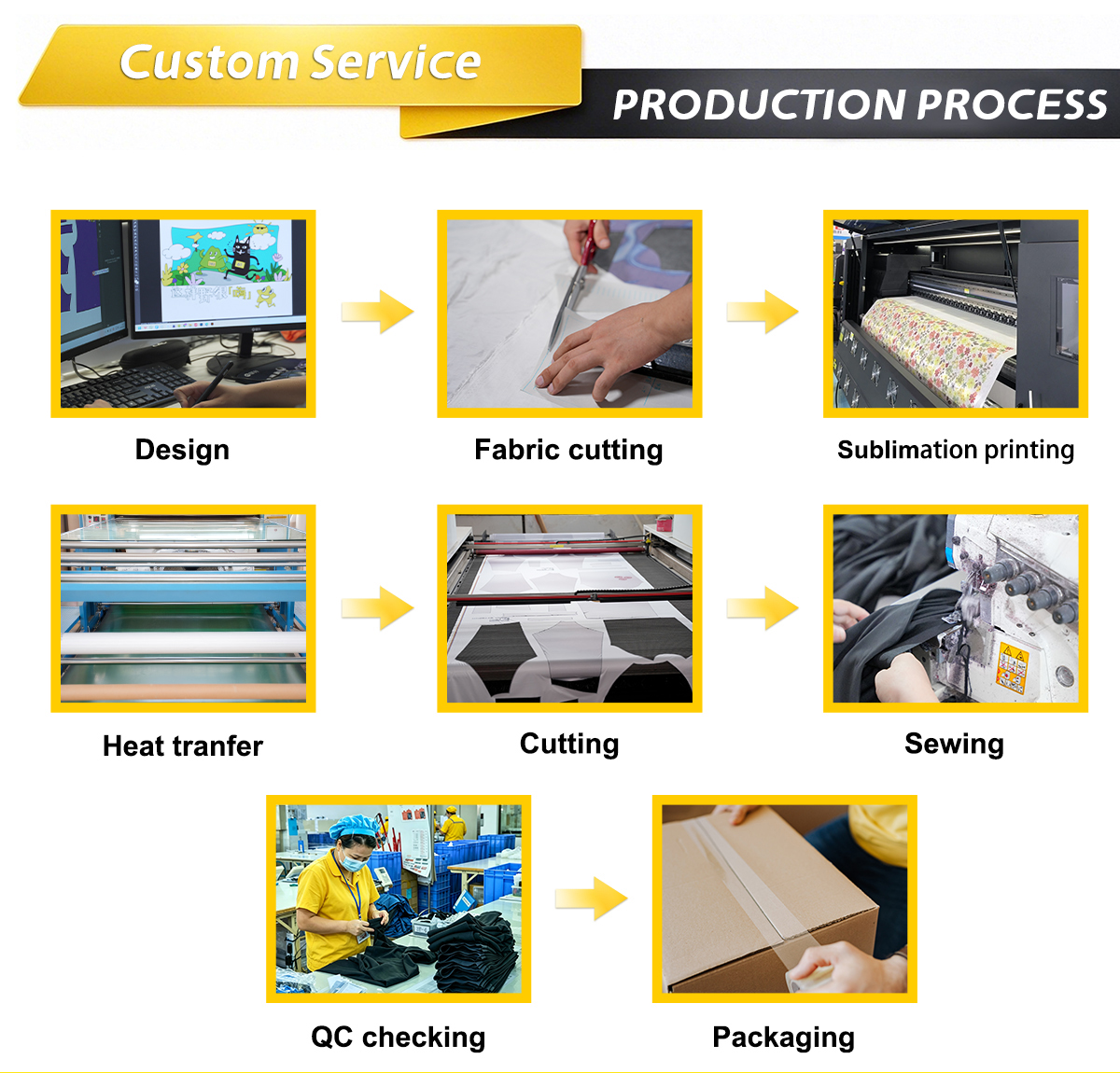
How the pack becomes a sample
Once a pack is complete, the sequence is fixed:
- 1. Design — flats and artwork are checked against the fabric choice
- 2. Fabric cutting — the sample is cut from the specified fabric, not a substitute
- 3. Sublimation printing — artwork is printed before cutting, so alignment can be judged
- 4. Heat transfer — additional decoration is applied to the panel
- 5. Cutting — panels are trimmed to final shape
- 6. Sewing — seams are built to the construction callout
- 7. QC checking — measured against the base size chart
- 8. Packaging — trims and labels applied as specified
Sampling runs five to seven working days from an approved pack, and bulk shipment fifteen days after sample sign-off. Those numbers only hold when the pack is complete; an open fabric question resets the clock.
Frequently asked questions
Do I need a tech pack for a one-piece order?
No. At one piece we can work from a photo and a few measurements. The pack becomes worth the effort once you are ordering the same style more than once, or across more than one colourway.
Can you write the tech pack for me?
We can build one from your reference, artwork and measurements as part of the free design step. What we cannot do is choose your fabric weight or fit for you — those are product decisions.
What format should a tech pack be in?
A single PDF is the most reliable. Spreadsheets are fine for measurement tables but lose the flats.
How detailed should the flats be?
Enough that every seam, panel break and trim placement is visible. A flat does not need to be beautiful; it needs to be unambiguous.
What if I only have a photo of an existing garment?
That is a starting point, not a pack. We can measure the garment and rebuild the spec with you, but the fabric weight and seam type still have to be decided explicitly — a photo cannot tell a sample room what a panel is made of.
Does a tech pack lock me into one factory?
No. A well-written pack is portable, which is one of its advantages. It also means a quotation from one factory can be compared fairly against another.
Send the pack, get a real number
If you already have artwork, measurements and a fabric direction, send them over — we will come back with a construction recommendation, a price and a delivery date. If you only have a reference garment and a deadline, send that instead; we will tell you what is missing before quoting.
Talk to our team · See finished work in the gallery · Browse custom accessories